
Cattle lying beds · poultry litter · stables · slurry · feed mills
Drier beds. Less ammonia in the air. And the nitrogen goes to the field.
Ammonium in wet bedding turns into ammonia gas, and animals breathing bad air eat less and grow more slowly. Clinoptilolite binds the ammonium before it becomes a gas.
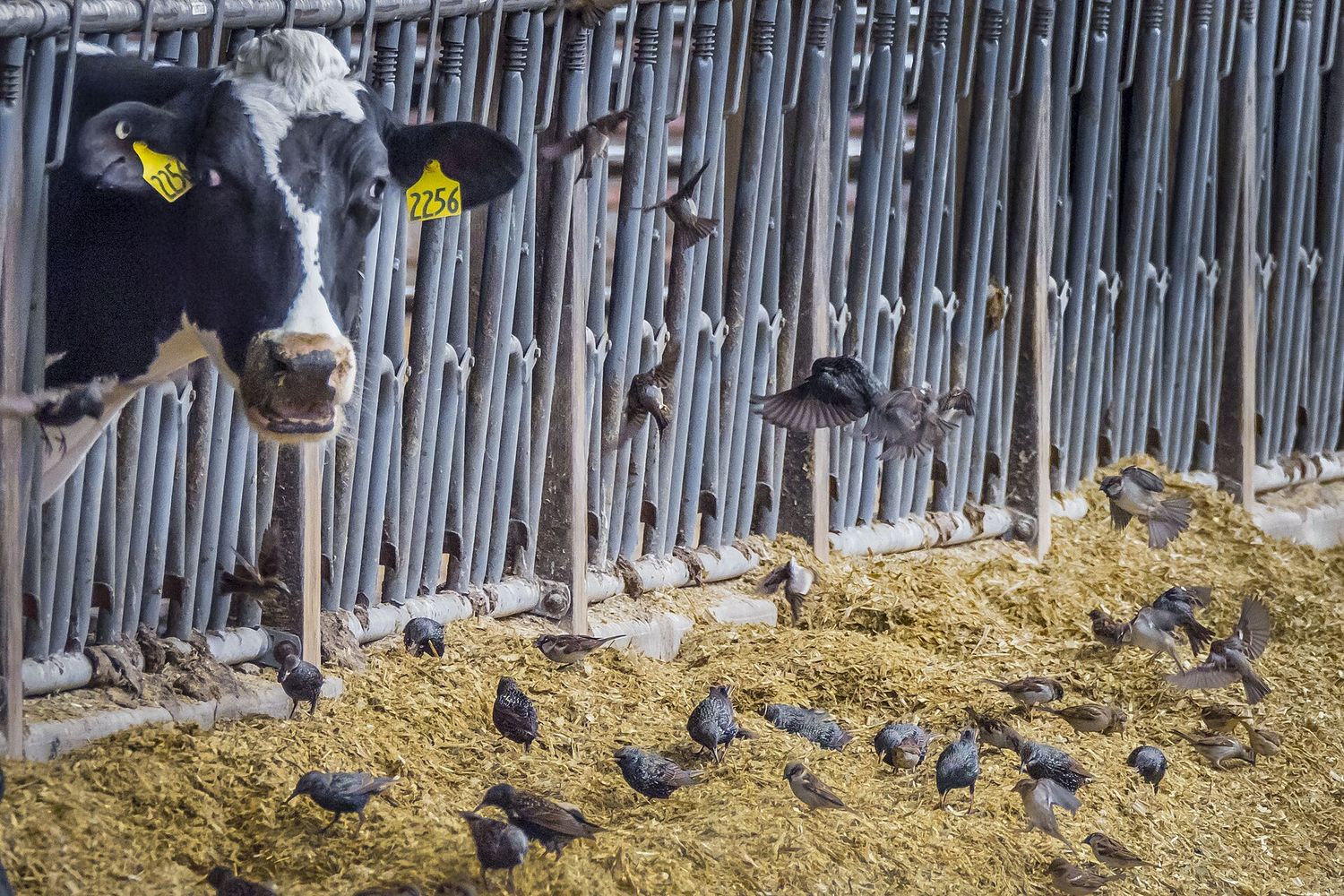
Walk into a cattle barn and the first thing you notice is the smell. That sharp, stinging smell is ammonia, and it comes from urine sitting on the floor. It rises into the air the animals breathe all day.
In a housed beef trial, controlling barn ammonia raised average daily gain from 0.744 to 1.066 kg/day — an environmental effect, not a dietary one. In layer housing, litter ammonia, pH and moisture were all substantially reduced. In stored pig slurry, ammonium nitrogen in the supernatant fell 59% and chemical oxygen demand 88%, most of it within two hours.
Then the second half of the return: when the bedding is cleared and spread on the field, the nitrogen the mineral caught goes into the soil instead of into the sky.
Bedding, litter and slurry products are not feed additives. They carry no inclusion ceiling and no functional-group limit, and they sell to the same farms through the same channel. We lead with bedding and follow with the feed additive, and the legal box around the second one is set out below.
Watch the two-minute film
What has actually been measured
- Average daily gain 0.744 → 1.066 kg/day through barn ammonia controlBozkurt 2006
- Litter NH₃, pH and moisture all substantially reducedMedras 2026
- Pig slurry: ammonium nitrogen −59%, COD −88%, most within two hoursVenglovský
- Slurry solids stabilised at 1–4% w/w over ten weeksVargová 2002
How to use it
- Cattle lying beds and poultry litter: <0.2 mm powder, spread on the bed surface, topped up with the normal bedding routine.
- Stables: 0.5–1.5 mm under the shavings or straw.
- Slurry stores: <0.2 mm at 1–4% by weight of the stored volume.
- Feed: <0.15 mm for premix and mill use, 0.2–1.0 mm for ruminant feed. Maximum 10,000 mg/kg of the complete feed — 1% of the ration.
- Particle size matters and is usually under-specified: finer grades bind faster. Tell us the application and we will tell you the grade.
What it will not do
In feed, clinoptilolite is authorised in the EU as additive 1g568 under Commission Implementing Regulation (EU) 2026/167, and that authorisation covers a technological binder and anticaking function only, at up to 10,000 mg/kg of feed. We make no health, detox, immune, joint or mycotoxin claim, because none is permitted and we would not make one anyway. Two published results in our own evidence base are null or negative — one found nothing at 0.5–1% in old layers, another found litter ammonia *rising* with dietary inclusion in broilers — and we would rather cite them ourselves than have you find them.
Bedding is the easy one to test: one shed treated, one not, for a fortnight, and you will smell the answer before you measure it.
Products and pack sizes
| Product | Grade | Pack |
|---|---|---|
| BED-POWDER-BB | <0,2 mm | 1.000 kg big bag |
| BED-POWDER-25 | <0,2 mm | 25 kg sack |
| EQ-BED-25 | 0,5–1,5 mm | 25 kg sack |
| SLURRY-BB | <0,2 mm | 1.000 kg big bag |
| FEED-FINE-BB | <0,15 mm | 1.000 kg big bag |
| FEED-FINE-25 | <0,15 mm | 25 kg sack |
| FEED-GRAN-BB | 0,2–1,0 mm | 1.000 kg big bag |
| EQ-POWDER-3 | 0,1–0,6 mm | 3 kg tub with scoop |
| EQ-POWDER-7.5 | 0,1–0,6 mm | 7,5 kg tub with scoop |
Specification
- Clinoptilolite content
- 93–100% (XRD)
- Cation exchange capacity
- 108–146 meq/100 g
- Bulk density
- 650–850 kg/m³
- pH
- 7.0–8.0
- Specific surface area
- 40 m²/g
- Pore diameter
- 0.43 nm
- Hardness (Mohs)
- 2–3
- Loss on ignition
- 6.4–15.8%
- Na₂O
- 0.3–1.3%
- Quartz
- 0–2%
Request products Download the four-page brochure (PDF)
Tell us the application and the volume. We answer with a written quotation.