
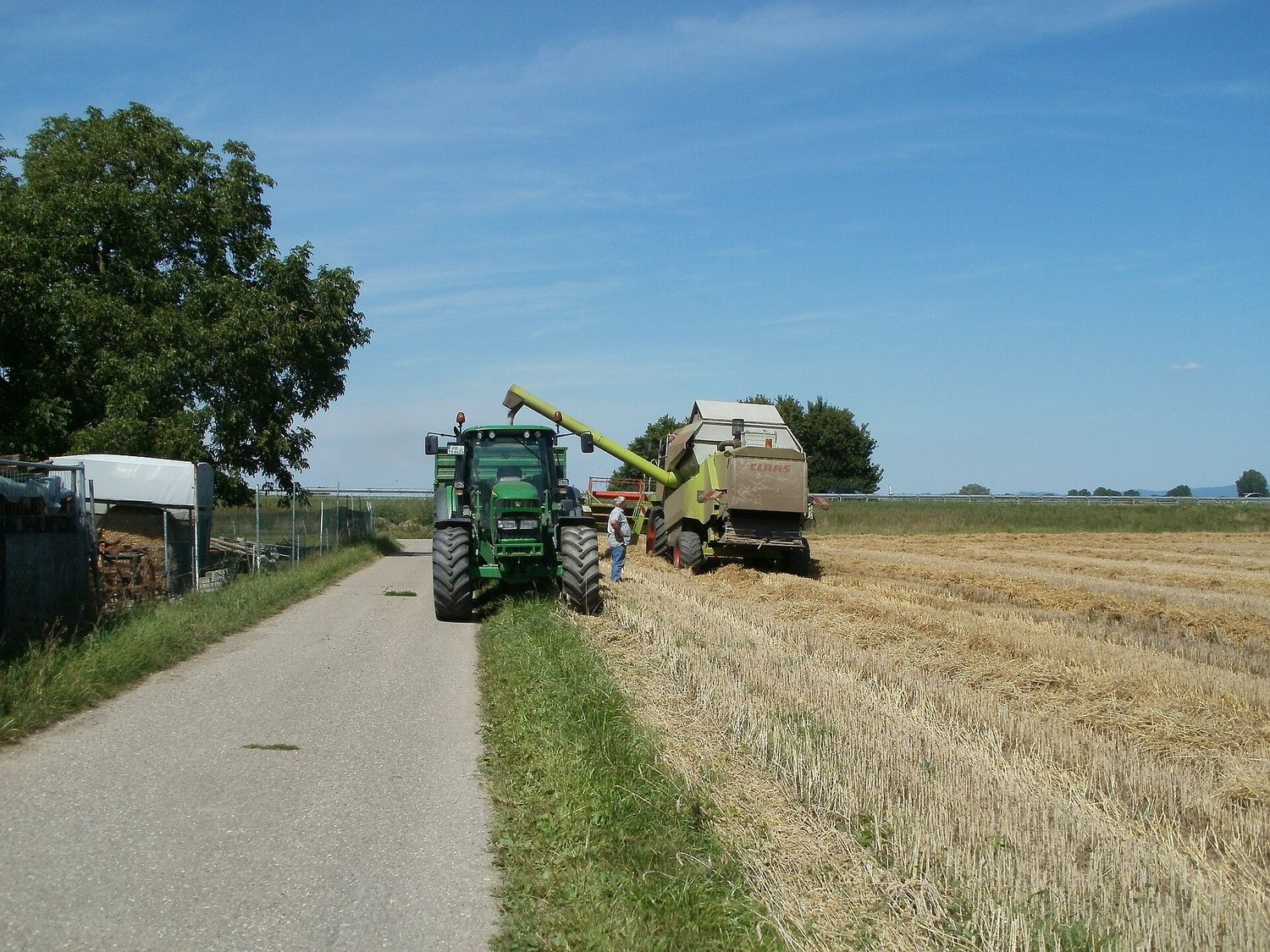
Arable · fertiliser blending · organic holdings
You buy the nitrogen. Keep it.
Between 40% and 70% of urea nitrogen never reaches the crop. Clinoptilolite holds ammonium where the roots are — blended into the fertiliser, not broadcast across the field.
Global measurements put nitrogen use efficiency at about 35%. The rest volatilises as ammonia, leaches as nitrate, or has sunk below the root zone by the time the crop wants it. Under a Danish nitrogen quota, every kilo lost is a kilo you cannot replace.
Clinoptilolite carries a permanent negative charge. Ammonium — NH₄⁺, the form nitrogen takes immediately after urea hydrolyses — binds to it, stays out of the soil water, and comes off again as the crop draws it down.
Blended 1:1 with urea in published trial work, ammonia volatilisation fell 47% in one soil and 32% in another, and ammonium leaching fell 13–28%. In Mexico, substituting a quarter of the nitrogen fertiliser with clinoptilolite produced 686 kg/ha more wheat grain than the full recommended nitrogen rate.
For a fertiliser blender it is a 25% inclusion that raises the value of the other 75%: 0.2–1.0 mm, free-flowing, non-hygroscopic, and it blends and spreads with granular urea and NPK without segregation at matched particle size.
Watch the two-minute film
What has actually been measured
- Ammonia volatilisation −47% and −32% in two soils, blended 1:1 with ureapeer-reviewed field and column work
- Ammonium leaching −13–28% in the same trialsame source
- +686 kg/ha wheat grain, replacing a quarter of the nitrogen fertiliserMexico
- Nitrogen use efficiency, unaided, is about 35%global measurement
How to use it
- Blend at around 25% by weight into your nitrogen fertiliser — the point is to keep the mineral beside the nutrient, where the concentration is high enough to matter.
- Or place it in the row with the seed, 1–3 mm grade through the drill.
- Not broadcast across the field. At the rate that would take, the arithmetic does not work and neither does the effect.
- Typical: 40–60 kg/ha in a blend.
- Batch certificates for clinoptilolite content, CEC, moisture and heavy metals with every consignment.
What it will not do
The published trials are from Mexico, Thailand, Egypt and Florida. There is no Danish field trial yet. The chemistry does not depend on climate, but the size of the effect might, and we are not going to pretend otherwise. It holds ammonium — not nitrate, not phosphate. And on a heavy clay soil that already has plenty of cation exchange capacity it will do very little.
We will part-fund a replicated strip trial on your own farm and publish the result whichever way it goes. That offer is the point: nobody in this market has a Danish number yet, and we would rather generate one than argue about Mexican ones.
Products and pack sizes
| Product | Grade | Pack |
|---|---|---|
| AGR-BLEND-BB | 0,2–1,0 mm | 1.000 kg big bag |
| AGR-BLEND-BULK | 0,2–1,0 mm | 24 t bulk |
| AGR-ROW-BB | 1–3 mm | 600 kg big bag |
| AGR-25 | 1–3 mm | 25 kg sack |
| AGR-ORG-25 | 1–3 mm | 25 kg sack |
| AGR-TRIAL | 0,2–1,0 mm | 200 kg trial kit |
Specification
- Clinoptilolite content
- 93–100% (XRD)
- Cation exchange capacity
- 108–146 meq/100 g
- Bulk density
- 650–850 kg/m³
- pH
- 7.0–8.0
- Specific surface area
- 40 m²/g
- Pore diameter
- 0.43 nm
- Hardness (Mohs)
- 2–3
- Loss on ignition
- 6.4–15.8%
- Na₂O
- 0.3–1.3%
- Quartz
- 0–2%
Request products Download the four-page brochure (PDF)
Tell us the application and the volume. We answer with a written quotation.